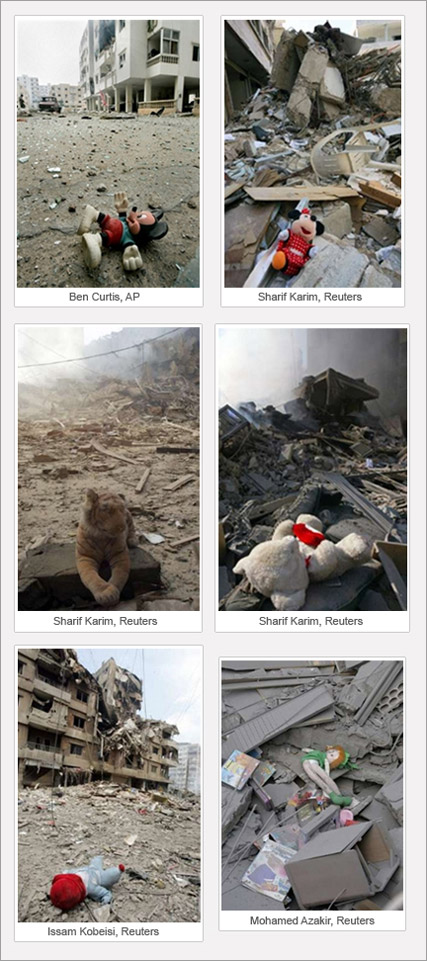
I wanted to speak with all the “toy photographers,” but found that only Ben Curtis, Chief Photographer/Photo editor, Middle East, of the Associated Press , was willing to be interviewed.
ERROL MORRIS: The first time I noticed your name in a blog was in connection with toys.
I wanted to speak with all the “toy photographers,” but found that only Ben Curtis, Chief Photographer/Photo editor, Middle East, of the Associated Press , was willing to be interviewed.
BEN CURTIS: It was after there had been a bunch of strikes on a housing estate in Tyre, that the Israelis had said was housing for Hezbollah operations. Very large strikes. We’d been outside the hospital in Tyre when we heard these huge explosions, and we could see smoke not too far away. We hit the ground. About 10, 15 minutes later, myself and a bunch of other journalists headed up to the scene, where a couple of multi-story apartment buildings had been completely flattened. And one of the pictures I took was a toy Mickey Mouse that was in the street. A number of blogs were suggesting that it had either been put there or moved there, or placed in the middle of the street, which of course it hadn’t. The buildings that hadn’t been flattened, but were directly opposite, half the contents of the apartments had been strewn into the street. There were sofas; there were children’s toys; there were books — all sorts of the usual things that you have in an apartment were scattered everywhere. Now, interestingly, when I sent that photo, the editors on the AP desk called me up and said, “Ben, we have to ask, was that toy there when you arrived? Was it moved? Was it placed there? Was it altered in any way, either by yourself or by other media?” These are the questions that, as an editor, you sometimes have to ask your photographers. Even if you have great trust in your people in the field, sometimes you have to go through asking those questions to make sure that what we put out is accurate.
ERROL MORRIS: So the call was routine?
BEN CURTIS: As an editor, if you have any suspicions at all about an image, you call up the photographer and say, “O.K., what happened? Where were you?” You interrogate the people in the field. I’ve worked a lot in Baghdad as an editor, and it’s especially important there. An incident occurs, maybe a roadside bomb or a truck bomb or some attack, and an hour later the reports start coming in, and you’ll have three completely different versions of events. Editing in Baghdad taught me that you have to slice through these multiple versions of events and come up with something that you can stand by. One side might say it was an IED that killed 10 American soldiers. The American military authorities might say, “No American soldiers were killed.” The Iraqi government might say, “Ten civilians were killed.” And if you have conflicting information that you can’t verify, then you don’t say it. You say, “The aftermath of an explosion of unidentified cause took place.” When I write my captions, I’m very meticulous and methodical, and I go through and check them before I send them, and I have to establish to my own satisfaction that everything I’ve said in the caption is true, and that I can stand by it because I’ve witnessed it myself with my own eyes, or I’ve questioned the people in the field and I’m confident that I can stand by that information .
ERROL MORRIS: Do you remember the caption that was put on the Mickey Mouse picture ?
BEN CURTIS: I don’t, but it was after the Reuters incident. I read the Reuters website after that, and there was a lot of handwringing and reevaluation of their procedures. After the war, I read that Reuters was working with Adobe on some software component for Photoshop that would keep a record of all the changes that had been made in Photoshop, so that editors could see exactly what had been done to an image. It would aid in preventing manipulation of photographs. I found that quite interesting from a technical perspective, and I could see how such thing could be useful in the work flow of maintaining accuracy of images. This was one of the things that was in my head when I was writing the “in defense of captions” post — while that’s useful or could be useful, a technical solution alone is never going to solve the problem of accuracy in the media. You could take a photographer’s image straight from the camera, not even processed with Photoshop, put it on the wire, and it’s the caption that provides the accuracy for that picture. The caption is the place where it’s easy to mislead the reader. [I have written about this in my essay “Photography as a Weapon.”] The caption is the thing that provides accurate context. And without an accurate context or with a misleading context, you can completely distort the meaning of an image. At the end of the day it comes back to old-fashioned ethics. You have to trust your people on the ground and you have to drill into them the ethical standards that your organization has. I remember the day after the Reuters incident I instructed a Lebanese photographer —